Sunday, April 21, 2019

Compsition Tip Using Positive and Negative Space

Shapes and forms exist in positive space. In this photo below the windmill and the sand dunes are the shape and form. The blue sky is the negative space. The sky balances the area occupied by the windmill and sand and provides balance to the photo.   The windmill forms the dominant feature of the photo by appearing in both the positive and negative space.  The negative space contains nothing that is visually important to the photo to take away from the dominant feature.


Friday, April 19, 2019

D-Day + 75 Years: Memorializing and Celebrating


© 2019 David Steely

The D-Day Memorial at Bedford, Virgina is a $25 Million memorial dedicated to those that lost their lives and those that fought on June 6, 1944 to capture the beaches and towns in Normandy, France. Their success ultimately lead to the defeat of Germany in May 1945.

On the first Tuesday in June 1944 Bedford City, Virginia was awakening to a new day. Milk deliveries were being made, and breakfasts were being prepared. People were getting ready for work. When everyone had turned in for the night on Monday there was little indication that the largest single invasion the world had ever known was unfurling. The Allies were attacking Fortress Europe.

The population of Bedford was about 3,200. It wasn’t much different than any other small American town. By 1944 most of its young men 18 to 30 years old were in uniform. They had been dispersed to all points of the world. Many had been serving proudly as members of the National Guard when the Japanese attacked Pearl Harbor in 1941. The Army quickly rolled these men into the 29th Infantry Division. They were shipped to England in September 1942. It was assumed at that time they would at some point be invading Europe. 

On the home front war news was delivered in newspapers daily with multi-column headlines and with regularity on radio news broadcasts with special bulletins as the news warranted. Although the headlines were dramatic none of them were to claim the attention of the American public as intently as those of December 7, 1941 until June 6, 1944.

Originally set for June 5, the invasion was postponed for a day as the Allied command staff waited for a break in the weather that would clear the skies and calm the seas for the invasion. The men had been loaded on their landing crafts and ships on June 4 in preparation to cross the English Channel. The military put a heavy cloak of censorship over any news preceding and during the invasion. Even as they were loading their boats to traverse the channel the vast majority of the soldiers didn’t know their final destination. They had been training for years for this moment but nothing could have fully prepared them for what happened. 

The invasion of Europe was on. The heavily censored news reports began to reveal the size and importance of the invasion. All across the country a news hungry public gathered around radios to listen to war correspondents' reports. Newspapers put out extra editions. Early reports were very general in nature. The Allies had attacked. The beaches had been taken. The troops were advancing inland. As expected, there were casualties.

On this fateful morning Bedford was set apart. No other city, no matter the size, would suffer as many casualties on D-Day and during the following battle for Normandy as this little town. Their brave soldiers had been destined for the beaches in Normandy that had been code named Omaha. They had been in the first wave to approach the beaches and many of them never lived to set foot on French soil. More than 1,000 soldiers died on June 6 at Omaha. Specific details regarding the invasion didn’t start filtering back to the United States for weeks as the army counted its casualties and consolidated its gains. The headlines about casualties were eventually supported by a flurry of telegrams authorized by the Department of Defense. D-Day became very personal for many.

Outside of the telephone, telegrams were the fastest and most personal way of communicating during the war. They carried with them a sense of urgency and importance. And it was effectual in that it was hand delivered to the recipient. Births were announced with them. Travel schedules were sent ahead to families and friends with them. Bad news was sadly delivered with them.

It wasn’t until July 17 that the first D-Day telegrams arrived at the teletype at Greens Drug Store in Bedford.  Over the next few days families would receive the most dreaded telegram of all.

  “The Secretary of War expresses his deepest regret that your son was killed in action on six June in France.”

© 2019 David Steely

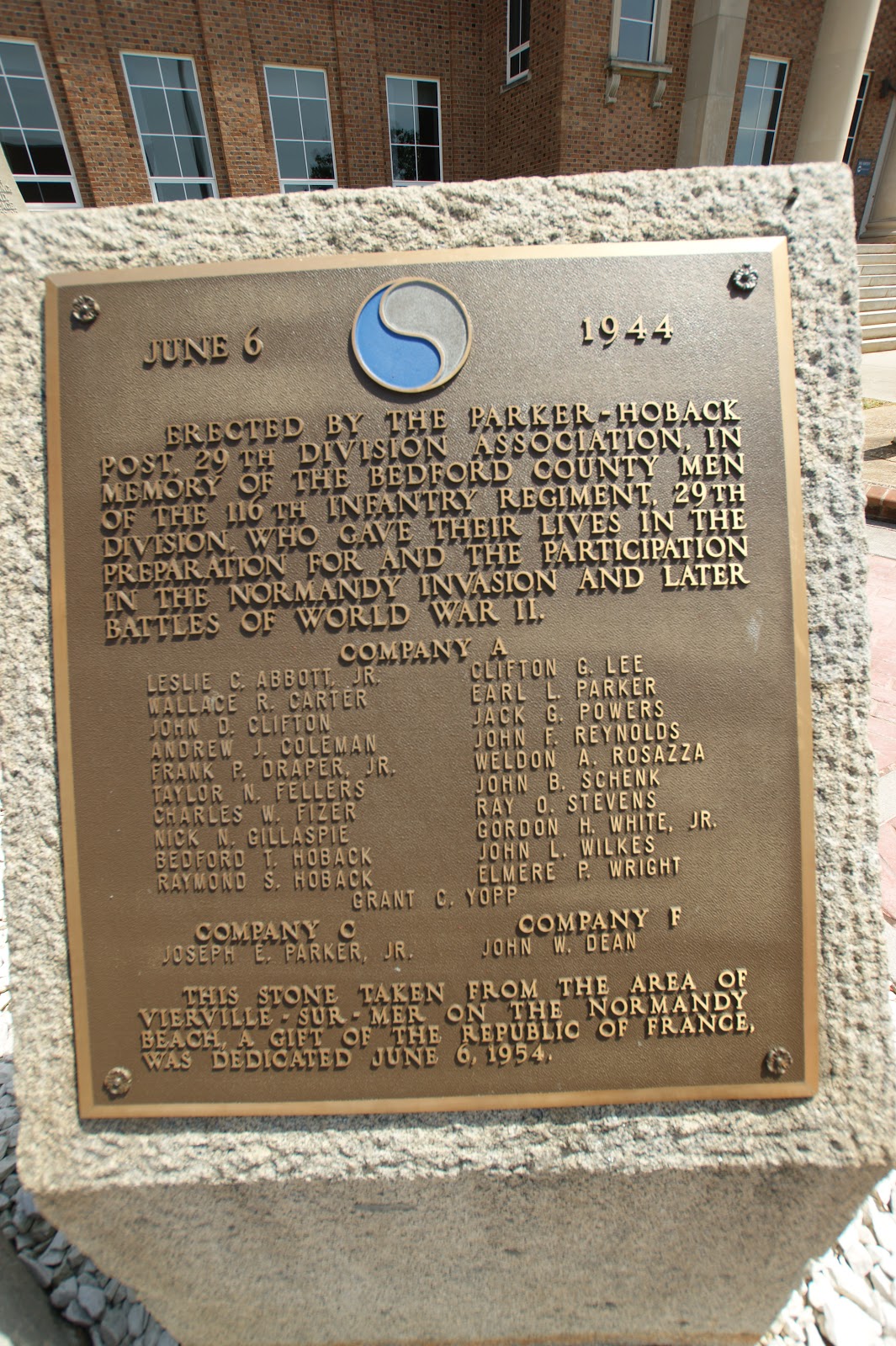
The City of Bedford monument to the young men who died on D-Day and the battle for Normandy sits in the town center on the county court house grounds. It is not a part of the D-Day Memorial but the community's own tribute to them.

In all 23 telegrams announcing those KIA arrived related to the D-Day invasion. The military was very efficient and began releasing the notices almost simultaneously. Each new notice that came in over the teletype at Greens Drug Store brought dread and sadness began to envelop the town.

Nineteen Bedford boys lost their lives on June 6. All were part of Company A, 116th Infantry Regiment, 29th Infantry Division. Four more were to be killed within the next few days. Bedford’s total contribution of man power to the invasion was 30 soldiers.  These numbers don't include the wounded.  This made the casualty count for Bedford the highest per capita of any town in the United States. Company A itself was decimated. It lost so many boys in the first hour of the invasion that it was rendered useless as an effective military unit.

It was because of this great loss of human life to such a small community that Bedford was able to get the attention of the United States Congress. Congress agreed that a D-Day memorial was needed and it was befitting to be located at Bedford. President George H. W. Bush presided at a dedication of the 88 acre memorial on June 6, 2001.


© 2019 David Steely

As this 75th anniversary approaches, plans are being made at both the D-Day Memorial and in Normandy, France to mark this enormous achievement. It is universally recognized that this year’s celebrations will probably be the last gathering of the D-Day veterans in large numbers as those still living are celebrating life in their 90s. And they will more than likely hear once again General Dwight D. Eisenhower’s words of encouragement to them one more time:

“You are about to embark upon the Great Crusade, toward which we have striven these many months. The eyes of the world are upon you. The hopes and prayers of liberty-loving people everywhere march with you. 

In company with our brave Allies and brothers-in-arms on other Fronts, you will bring about the destruction of the German war machine, the elimination of Nazi tyranny over the oppressed peoples of Europe, and security for ourselves in a free world.

Your task will not be an easy one. Your enemy is well trained, well equipped and battle hardened. He will fight savagely.

But this is the year 1944! Much has happened since the Nazi triumphs of 1940-41. The United Nations have inflicted upon the Germans great defeats, in open battle, man-to-man. Our air offensive has seriously reduced their strength in the air and their capacity to wage war on the ground. Our Home Fronts have given us an overwhelming superiority in weapons and munitions of war, and placed at our disposal great reserves of trained fighting men.

The tide has turned! The free men of the world are marching together toVictory!

I have full confidence in your courage and devotion to duty and skill in battle. We will accept nothing less than full Victory! 

Good luck! And let us beseech the blessing of Almighty God upon this great and noble undertaking.”

― Dwight D. Eisenhower


© 2019 David Steely

© 2019 David Steely

© 2019 David Steely

© 2019 David Steely

© 2019 David Steely

© 2019 David Steely

© 2019 David Steely

© 2019 David Steely

© 2019 David Steely

For more information on the D-Day Memorial and the events scheduled go to their web site at https://www.dday.org/events/.

For more information on in events planned in Normandy go tohttp://bayeux-bessin-tourisme.com/en/event/d-day-festival-normandy/

For more information on events planned worldwide go tohttp://www.dday-anniversary.com/downloads/D-Day75Events%20v1.0.pdf

Tuesday, August 28, 2018

All in one frame.


Oh my!  Zebra, and elk, giraffes, and.......what?  My grandson?  If you are going to spend the bucks on entertainment you might as well take pictures.  At Grapeland (Texas) Safari you take your car into the park.  These exotic animals probably think of us as a free vending machine.  At the store at the entry to the park they'll sell you a plastic picnic cup full of feed to lure the animals to you.  Yep, you'll want to take pictures. And if you have all four windows down you'll be busy trying to capture the best one.  I happen to like this one.  It captures the animals and the excitement of my grandson sitting behind me and saved me from wrenching my back.  However, you might want to make sure you have a clean mirror if you want to try this.

How much snow did we get? Knee high to a what?


More times than not it's easier to use a photograph to explain something than using words.

Someone may ask: "How much snow did we get last night?"  If you reply 20 inches that may not compute with a lot of people.  But everyone knows about picnic tables and can relate to how tall they are.

"It snowed so much it covered the picnic table benches and almost came to the top of the picnic table."

But send them a picture and it is self explanatory.  

Tuesday, July 10, 2018

Tank It Up At The Texas Military Forces Museum


Driving South on MOPAC 1 in Austin, Texas it’s hard not to notice when you are passing Camp Mabry.  Vintage helicopters and jet planes hoisted high on supports line a walking track circling a century old drill field.  You can’t miss the old Austin stone warehouses that are as orderly and functional as when they were built over 100 years ago.


Still an active military base, the camp is not only home to the Texas Military Forces (Texas Army National Guard, Texas Air National Guard and Texas State Guard) but also the Texas Military Forces Museum.


The Museum is a treat!  I’ve brought my grandchildren here several times.  Entry to the camp, and thus the museum, is via a guarded gate where you’ll have to present a photo ID.  


A short drive beyond the gate delivers you to a 45,000-square foot old warehouse building with a wooden double door entry.  Using space made available by the camp the museum offers a representation of uniforms, photographs, army tanks, military vehicles, artillery, ground weapons, helicopters, and jet fighters used by Texas soldiers in the fight for freedom.


The Texas Military Forces Museum explores the history of the Lone Star State’s militia and volunteer forces from 1823 (date of the first militia muster in Stephen F. Austin’s colony) to 1903 when the Congress created the National Guard. From 1903 to the present the museum tells the story of the Texas Army and Air National Guard, as well as the Texas State Guard, in both peacetime and wartime.


Permanent exhibits utilize uniforms, weapons, equipment, personal items, film, music, photographs, battle dioramas and realistic full-scale environments to tell the story of the Texas Military Forces in the Texas Revolution, the Texas Navy, the Texas Republic, the Mexican War, the Battles along the Indian Frontier, the War between the States, the Spanish-American and Philippine-American Wars, World War I, World War II, the Korean War, the Cold War, Peace Keeping Deployments and the Global War on Terror.


Living history programs, battle reenactments and other special events take place throughout the year. Admission to the museum is always FREE.

HOURS:
Tuesday to Sunday 10 am to 4 pm
Office staff is available Monday to Friday 8 am to 4 pm.

Driving Directions to the museum:
The Texas Military Forces Museum is located in Building 6 on Camp Mabry in Austin, Texas. The street address of Camp Mabry is 2200 West 35th Street. The mailing address is P.O. Box 5218, Austin, TX 78763. The former entrance to the post was blocked in 2001, the current entrance is on Maintenance Drive.

From the MOPAC Expressway (aka, Loop 1).
  1. Exit the MOPAC Expressway at 35th Street.
  2. Drive west 6/10ths of a mile past the old main gate, which is now barricaded, and go through the light at Exposition, and down a steep hill.
  3. At the bottom of the hill, just before a flashing traffic signal, you will see the gated entrance of Camp Mabry to your right (i.e., Maintenance Drive).
  4. After passing through security, go straight to the stop sign and turn right.
  5. At the next stop sign, turn right again.
  6. Follow General Mabry Boulevard past the running track on your left.
  7. Building 6 will be on your right, next to an outdoor display of tanks and military vehicles.
  8. The main entrance for the Museum is the large white double doors at the center of the building.
From IH-35.
  1. Make certain you are on the lower level of the Interstate.
  2. Take the 38½ Street exit going west. Note that as it proceeds westward, 38½ Street becomes 35th Street.
  3. After crossing over Loop 1, follow the instructions above.
From the Airport.
  1. Take Highway 71 West to Highway 360 North
  2. Highway 360 North to Loop 1 North.
  3. Travel five (5) miles on Loop 1 to 35th Street.
  4. Follow the instructions above from that point.
GPS Address 3038  W 35th St. Austin, Tx 78703

At the current time, the post is open to the public during daylight hours without prior arrangements. The security guards, however, may require you to present some form of valid state or federal identification and to consent to a search of the vehicle.


Wednesday, July 4, 2018

Cheap & Sweet Way To Catch A Wave!


Want to take a fun picture of the kids jumping into a swimming pool this summer?  It’s easy enough but there are some basic tips to make the picture better.  Watch for the sun.  Make sure it’s not behind the subjects.  Have the subjects line up on the side of the pool that is most aligned with the direction of the sun.  Not only will this give you plenty of front lighting, the reflection of the sun off the pool will act as fill lighting.  Get into the pool!  It makes a better picture shooting up than shooting across or down at the subject.  Take several shots!  Don’t depend on just one but repeat the shots as long as your subjects will participate.  
You don’t have to have an expensive camera to get some really great family and vacation photos.  I think today most of us are using some type of digital camera, either the one on our cell phone or a point-and-shoot type.  Personally, most of the pictures I take on trips and special events are with my digital single lens reflex Sony with a 5 lens selection from a 14mm wide angle up to a 500mm.
BUT I find I take a lot of family related pictures with a small handheld digital camera.  Which brings me to the topic of taking pictures with a waterproof camera.  I bought my small point-and-shoot just for the purpose of taking pictures of the grandchildren at places I don’t want to haul around my camera bag.
However, you don’t really have to have a digital camera to get into the water and catch the family floating down the Guadalupe River, swimming under water, or just wrestling over a floating tube.  There are still some simple underwater film cameras that can capture just the right moment the 5-year old reached the bottom of the pool and snatched the sunken ring off the bottom.
Fuji and Kodak both make waterproof film cameras that are available in stores or from an online retailer.  The only big downside is you still have to get the film processed and the digitized by the processor if you want digital copies.  Otherwise, the quality is acceptable acceptable for family purposes. 
Another downside is you don’t have the ability to see if the picture you just took is one you want.  I had my grandchildren crawl out of the pool and jump back in several times before I got a picture I wanted with my waterproof digital.  I would have been hoping for this shot if I had been using film.  This isn’t to say I haven’t gotten a lot of keepers with film.  Some of my favorite underwater pictures were taken with a Kodak waterproof camera.  The films for both Fuji and Kodak are rated 800 which is plenty fast but they worked best for me when my subject with within a range of 3-6 feet from the camera on a bright sunny day.
The disposable film cameras are light enough and cheap enough to not fret about them floating to the bottom.  But if you don’t want to lose even an inexpensive digital point-and-shoot, then for a few bucks you can add a floating strap that will keep it on the surface if you drop it.

Wednesday, June 13, 2018

Slow down on Mackinac Island. You really don't have a choice!


Mackinac Island in northern Michigan has not been on my travel radar until last year.  It has, however, been in my wife’s travel plans for years.  So we went.  And I’m not sorry we did.  Actually, it became a 3 night stop on a circle drive around Lake Michigan that started and ended in Chicago.


To describe it as quaint is basically an understatement.  In the last century some far sited citizens decided to ban car and trucks on the island.  So they rely basically on horse drawn carriages, bicycles, and walking to get around including delivering everyday supplies used on the island. 


Access to the island is by ferry, private boat, or small plane except in winter when the lake freezes and creates an ice bridge.  But, I’m not sure I want to be on the island in the winter when the population shrinks to a few hundred since tourist season is closed.  Temperature then hovers too close to zero degrees for me.


But come the thaw and its “Katy bar the door!”  Visitors flock to the island from all over the world to enjoy sailing, golfing, shopping, eating and lazing around.  Thousands arrive daily during the temperate summer months and for island events.  We arrived the weekend following the end of the high tourist season.  For some establishments, the Labor Day Weekend is the end of the season.  Starting the next week the horse population begins to shrink as the owners move them inland, the people in the service community have either left or are planning to leave, and life on the island begins to slow way down.  Fortunately for me several of the famous fudge shops were still open.


The whole place is a movie set and you’ll have “déjà vu” moments often, especially if you’ve watched Jane Seymour and Christopher Reeves in the movie “Somewhere in Time.”  The long porch of the famous Grand Hotel screams out to come sit, sip, and chat.  Walking the streets past Victorian era houses and hotels, each dressed out in splendid colors and blooming gardens, will harken back thoughts to when only horses and mules were the only transportation on the island anyway.


Since our stay came as the island was beginning to turn out the lights for the season, there was not a crowd anywhere we went.  Our apartment accommodation for 5 was located about 2 miles from the docks and shopping.  We loaded up on groceries at the only true grocery store open on the island before hopping on a scheduled run of a horse drawn taxi.  If you lodging is away from the downtown I do recommend that you plan on a lot of walking renting a bike since the taxi conveniences are sporadic. 


The island has history and Fort Mackinac is well preserved.  It has a fantastic view over the island and out across the lake.  It’s well worth the visit.  It’s an interesting ½ day diversion before slipping down to the main drag for a cold one at one.

An impressive site as your ferry pulls up to its berth at the docks are the thousands of bicycles parked for rent.  This is proof that off-season does have it advantage: what if all of the bikes were out at one time during the high season?

Probably the most popular ways to get around is with horse-drawn carriage tours with an entertaining and well-informed guide for an intimate and informative experience. Drive-your-own buggies are also available for vacationers who prefer to direct themselves.


There are plenty of walking and bike trails. And there’s plenty of ground to cover, with over 70 miles of natural and paved trails to keep you occupied all day long.  Some of the hills are a test for us folks of moderate exercise habits but manageable.  Mackinac Island State Park, which covers more than 80% of the Island, is open for your exploration. 

I didn’t play golf while we were visiting here but you can hear the whisper of a challenge walking along fairways and by greens near the walk paths.

This is a well-known and popular destination but it’s not mandatory to stay in one of the 1,500 plus available rooms on the island to enjoy it.  It easy to stay at one of the hotels in and around Mackinac City on the shoreline across from the island.  You can valet park at the ferry launch and take a day trip.

The Mackinac Island Tourism Bureau has an excellent and easy to navigate web page to keep you up-to-day on the island year around.  We used it for planning our trip and recommend it highly.

Mackinac Island Tourism Bureau
7274 Main Street, P.O. Box 451
Mackinac Island, MI 49757
(906) 847-3783

General Inquiries
Email: info@mackinacisland.org
Telephone: (800) 454-5227
Local: (906) 847-3783